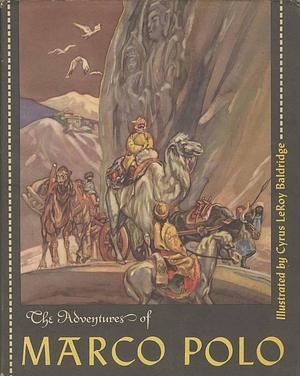

The Adventures of Marco Polo
3 stars
1) "It should be known to the reader that, at the time when Baldwin II was emperor of Constantinople, where a magistrate representing the doge of Venice then resided, and in the year of our Lord 1260, Nicolo Polo, the father of the said Marco, and Maffeo, the brother of Nicolo, respectable and well-informed men, embarked in a ship of their own, with a rich and varied cargo of merchandise, and reached Constantinople in safety. After mature deliberation on the subject of their proceedings, it was determined, as the measure most likely to improve their trading capital, that they should prosecute their voyage into the Euxine or Black Sea."
2) "To the north lies Zorzania [Georgia], near the confines of which there is a fountain of oil which discharges so great a quantity as to furnish loading for many camels. The use made of it is not for the …
1) "It should be known to the reader that, at the time when Baldwin II was emperor of Constantinople, where a magistrate representing the doge of Venice then resided, and in the year of our Lord 1260, Nicolo Polo, the father of the said Marco, and Maffeo, the brother of Nicolo, respectable and well-informed men, embarked in a ship of their own, with a rich and varied cargo of merchandise, and reached Constantinople in safety. After mature deliberation on the subject of their proceedings, it was determined, as the measure most likely to improve their trading capital, that they should prosecute their voyage into the Euxine or Black Sea."
2) "To the north lies Zorzania [Georgia], near the confines of which there is a fountain of oil which discharges so great a quantity as to furnish loading for many camels. The use made of it is not for the purpose of food, but as an unguent for the cure of cutaneous distempers in men and cattle, as well as other complaints; and it is also good for burning. In the neighboring country no other is used in their lamps, and people come from distant parts to procure it."
3) "There is no oil of olives, but they express it from certain nuts, and from the grain called sesame, which resembles the seed of flax, excepting that it is light-colored; and the oil this yields is better, and has more flavor than any other. It is used by the Tartars and other inhabitants of these parts."
4) "It is asserted as a well-known fact that this desert [Gobi] is the abode of many evil spirits, which amuse travellers to their destruction with most extraordinary illusions. If, during the day-time, any persons remain behind on the road, either when overtaken by sleep or detained by their natural occasions, until the caravan has passed a hill and is no longer in sight, they unexpectedly hear themselves called to by their names, and in a tone of voice to which they are accustomed. Supposing the call to proceed from their companions, they are led away by it from the direct road, and not knowing in what direction to advance, are left to perish."
5) "When his majesty makes his progress in this manner, towards the shores of the ocean, many interesting occurrences attend the sport, and it may truly be said that it is unrivalled by any other amusement in the world. On account of the narrowness of the passes in some parts of the country where the grand khan follows the chase, he is borne upon two elephants only, or sometimes a single one, being more convenient than a greater number; but under other circumstances he makes use of four, upon the backs of which is placed a pavilion of wood, handsomely carved, the inside being lined with cloth of gold, and the outside covered with the skins of lions, a mode of conveyance which is rendered necessary to him during his hunting excursions, in consequence of the gout, with which he is troubled."
6) "In this city of Kanbalu is the mint of the grand khan, who may truly be said to possess the secret of the alchemists, as he has the art of producing money by the following process. He causes the bark to be stripped from those mulberry-trees the leaves of which are used for feeding silk-worms, and takes from it that thin inner rind which lies between the coarser bark and the wood of the tree. This being steeped, and afterwards pounded in a mortar, until reduced to a pulp, is made into paper, resembling (in substance) that which is manufactured from cotton, but quite black. When ready for use, he has it cut into pieces of money of different sizes, nearly square, but somewhat longer than they are wide. Of these, the smallest pass for a denier tournois; the next size for a Venetian silver groat; others for two, five, and ten groats; others for one, two, three, and as far as ten besants of gold. The coinage of this paper money is authenticated with as much form and ceremony as if it were actually of pure gold or silver; for to each note a number of officers, specially appointed, not only subscribe their names, but affix their signets also; and when this has been regularly done by the whole of them, the principal officer, deputed by his majesty, having dipped into vermilion the royal seal committed to his custody, stamps with it the piece of paper, so that the form of the seal tinged with the vermilion remains impressed upon it, by which it receives full authenticity as current money, and the act of counterfeiting it is punished as a capital offence."
7) "The men also form dark stripes or bands round their arms and legs, by puncturing them in the following manner. They have five needles joined together, which they press into the flesh until blood is drawn; and they then rub the punctures with a black coloring matter, which leaves an indelible mark. To bear these dark stripes is considered as an ornamental and honorable distinction."
8) "On leaving Singui-matu and travelling towards the south for sixteen days, you unceasingly meet with commercial towns and with castles. The people throughout the country are idolaters, and subjects of the grand khan. They burn the bodies of their dead and use paper money."
9) "In other streets are the habitations of the courtesans, who are here in such numbers as I dare not venture to report: and not only near the squares, which is the situation usually appropriated for their residence, but in every part of the city they are to be found, adorned with much finery, highly perfumed, occupying well furnished houses, and attended by many female domestics. These women are accomplished, and are perfect in the arts of blandishment and dalliance, which they accompany with expressions adapted to every description of person, insomuch that strangers who have once tasted of their charms, remain in a state of fascination, and become so enchanted by their meretricious arts, that they can never divest themselves of the impression. Thus intoxicated with sensual pleasures, when they return to their homes they report that they have been in Kin-sai, or the celestial city, and pant for the time when they may be enabled to revisit paradise."
10) "We shall now treat separately of what relates to the inhabitants of each of these kingdoms; but in the first place it is proper to observe that the island [Sumatra] lies so far to the southward as to render the north star invisible."